
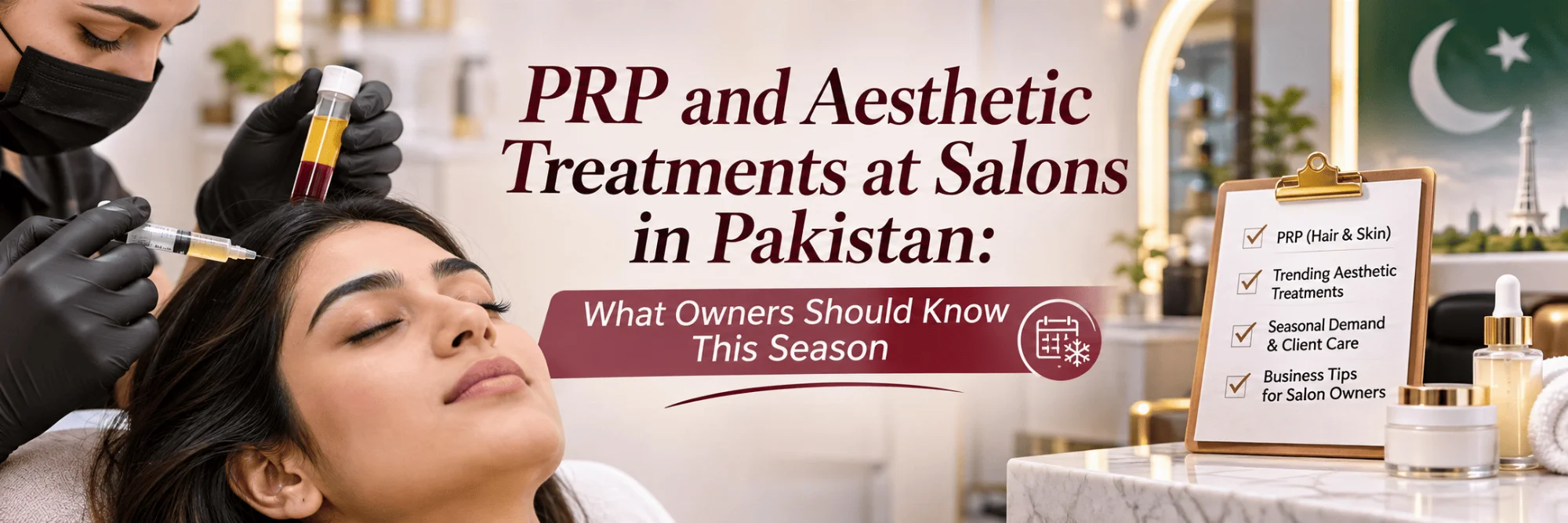
PRP is being widely promoted on social media in Pakistan, so sooner or later a client may ask your salon, "Do you do this?" It is tempting to say yes. But PRP is not a facial or a hair spa, and in Pakistan the line between a beauty service and a healthcare service matters.
This guide explains what the recent reporting says about the PRP trend, what the Punjab Healthcare Commission (PHC) has been inspecting, and how you can serve these clients well without putting them or your salon at risk.
Why PRP is in the news right now
On 25 October 2026, Dawn reported that Platelet Rich Plasma (PRP) therapy is gaining popularity in Pakistan for hair restoration and skin rejuvenation, and that it is widely promoted on social media as a solution for hair loss, acne scars and youthful skin. The article describes PRP as one of the most sought after aesthetic procedures.
The dermatologists Dawn spoke to were clear about what the treatment involves. It means drawing a small amount of the patient's blood, separating the platelet rich plasma through centrifugation, and injecting it into the skin or scalp, or applying it through microneedling. They said it should always be performed under qualified medical supervision.
They also made three points every salon owner should hear:
- It is not for everyone. Dr Shawana Sharif told Dawn: "Not every patient with hair loss or facial ageing requires PRP. The underlying cause must first be diagnosed before deciding on the most appropriate treatment."
- It is rarely one session. According to the report, many patients need multiple sessions followed by maintenance treatment.
- Where it is done matters. Experts cautioned against the growing number of cosmetic procedures performed outside licensed medical facilities, saying treatment by untrained practitioners can increase the risk of infections and poor results.
What the Punjab Healthcare Commission has been checking
If your salon is in Punjab, the PHC is the regulator to know. Its licensing page says that a healthcare establishment includes a medical clinic or "any other premises or conveyances wholly or partly used for providing healthcare services", and that no healthcare establishment can operate without a PHC licence. If an establishment fails to get licensed in time, the PHC says it may impose a fine which may extend to Rs. 500,000 or order the establishment closed.
The PHC is actively inspecting. According to a PHC statement reported by The Nation on 3 October 2026, the commission carried out 1,856 inspections across Punjab in September, and 143 of them were at aesthetic clinics. Across all inspections, it issued notices to 104 establishments, suspended specified services at 36 facilities and sealed four centres.
The problems it listed are worth reading closely, because several apply directly to anyone offering skin procedures:
- Providing services beyond the approved scope or category of registration
- No appropriately qualified and registered doctors or consultants
- Poor maintenance of patient medical records
- Weak infection prevention and control, and improper disinfection and sterilisation
- Expired medicines, reagents or disposable items
The PHC has also issued a directive that training in aesthetic procedures at healthcare establishments must be led only by PMDC accredited faculty, as posted on its official LinkedIn page.
We are not lawyers or regulators, and this guide is not legal advice. If you are unsure whether a service you offer counts as a healthcare service, ask the PHC directly before you start it. Salons outside Punjab should check with the healthcare regulator in their own province.
Beauty service or medical procedure? A simple way to think about it
A useful question to ask about any treatment on your menu is this: does it involve drawing blood, injecting anything, or a diagnosis by a doctor? PRP, by the description in Dawn's report, involves all three. Treatments like that belong with a qualified, registered medical practitioner working from a properly licensed establishment.
That does not mean your salon has to lose these clients. It means choosing the right setup.
Option 1: Refer to a trusted, licensed clinic
Build a relationship with a registered dermatologist or a PHC licensed aesthetic clinic near you. When a client asks about PRP, you can refer them with confidence and keep serving them for everything else: hair care, colour, facials, makeup and bridal packages. You keep the relationship, and the client gets the treatment from the right person.
Option 2: Partner with a doctor who runs a licensed clinic
Another route is to work alongside a qualified doctor who runs a licensed clinic. If you consider this, the clinic side needs its own registration and licensing with the PHC, and the doctor should be the one assessing each patient and performing the procedure. The PHC's fee page lists licence fees by category for five years, for example Rs 40,000 for a Single Speciality Clinic and Rs 75,000 for Cosmetic Surgery, Hair Transplant and Liposuction Centers. Confirm the right category for your setup with the PHC itself.
Option 3: Grow the services you already do well
Dawn's experts also said that simple habits such as regular cleansing, moisturising and daily broad spectrum sunscreen remain the foundation of healthy skin. That is good news for salons. Skin prep packages, home care advice and regular facials are services you can offer confidently.
How to talk to clients who ask for PRP
Your front desk will get this question, so give them a clear, kind answer to use. For example:
"PRP is a medical treatment, so we recommend having it done by a dermatologist. We can suggest a clinic we trust, and we'd love to plan your hair and skin care with you alongside it."
A few habits help:
- Don't promise results. The dermatologists in Dawn's report said many people expect one session to fix hair loss or wrinkles, and that is not the case.
- Be honest about commitment. Two women quoted by Dawn stopped PRP, one because of the recurring cost of maintenance sessions and one because of the long term commitment and repeated injections. Clients deserve that picture up front, whoever treats them.
- Keep your social posts accurate. Experts warned about clinics offering discounted procedures or making exaggerated claims on social media. Avoid before and after posts that suggest your salon performs treatments it does not.
Keep good records for every client
The PHC flagged poor record keeping as a common problem. Even for regular beauty services, a clear client history helps you serve people safely: what was done, which products were used, any allergies or sensitivities the client mentioned, and when they are due back.
This is where salon software earns its place. SalonFlow keeps customer profiles, appointment booking and daily billing in one system on every plan, starting with Starter Flow at PKR 8,000 per month. Pro Flow, at PKR 15,000 per month, adds SMS and WhatsApp messages, so you can remind clients about their next facial or bridal trial without chasing them by phone. Elite Flow, at PKR 28,000 per month, adds stock control, which helps you keep an eye on the products on your shelves. All plans include free support and owner and staff mobile apps.
A quick checklist for this week
- List every treatment on your menu and mark any that involve blood, injections or a doctor's diagnosis.
- For those treatments, decide whether to refer, partner with a licensed clinic, or stop offering them.
- If you are in Punjab and unsure, contact the PHC before offering any procedure in question.
- Brief your front desk on a kind, honest answer for PRP enquiries.
- Check your Instagram and Facebook posts for any claims you can't stand behind.
- Make sure each client's profile records allergies, products used and their next visit.
Frequently asked questions
Can a beauty salon in Pakistan offer PRP treatment?
PRP involves drawing a patient's blood and injecting the processed plasma into the skin or scalp. Dermatologists quoted by Dawn in October 2026 said it should always be done under qualified medical supervision. In Punjab, premises used for healthcare services need a Punjab Healthcare Commission licence. If you want to offer PRP, speak to the PHC or your provincial regulator first, or refer clients to a licensed clinic.
What did the Punjab Healthcare Commission find in its September 2026 inspections?
According to a PHC statement reported on 3 October 2026, the commission inspected 1,856 healthcare establishments in September, including 143 aesthetic clinics. It issued notices to 104 establishments, suspended specified services at 36 and sealed four. Problems included working beyond the registered scope, missing qualified doctors, poor patient records and weak infection control.
What is the penalty for running an unlicensed healthcare establishment in Punjab?
The PHC's licensing page says that if a healthcare establishment fails to be licensed within the required time, the PHC may impose a fine which may extend to Rs. 500,000 or order it to close.
How many PRP sessions does a client usually need?
Dawn's October 2026 report said PRP is often misunderstood as a one time fix, and that many patients need multiple sessions followed by maintenance treatment depending on their condition and response. The exact plan should come from the treating doctor.
How can salon software help with client safety?
Good salon software keeps each client's history in one place, so your team can see past services, products used and notes such as allergies before every appointment. SalonFlow includes customer profiling and appointment booking on all plans, and Pro Flow adds SMS and WhatsApp reminders.
Sources
- Dawn, "Experts urge caution over cosmetic treatment trend", 25 October 2026: https://www.dawn.com/news/2039566
- The Nation, "PHC conducts 1,856 inspections of healthcare facilities in Sept", 3 October 2026: https://www.nation.com.pk/03-Oct-2026/phc-conducts-1-856-inspections-healthcare-facilities-sept
- Punjab Healthcare Commission, Introduction to Licensing: https://os.phc.org.pk/licensingIntro.aspx
- Punjab Healthcare Commission, Licensing FAQs: https://os.phc.org.pk/licensingFAQs.aspx
- Punjab Healthcare Commission, Registration and Licensing Fees: https://os.phc.org.pk/licensingfee.aspx
- Punjab Healthcare Commission on LinkedIn, directive on aesthetic procedure training: https://www.linkedin.com/posts/punjab-healthcare-commission_phc-punjabhealthcarecommission-aesthetictraining-activity-7519301352624312321-KO4O
- SalonFlow pricing, checked 2 November 2026: https://salonflowpos.com